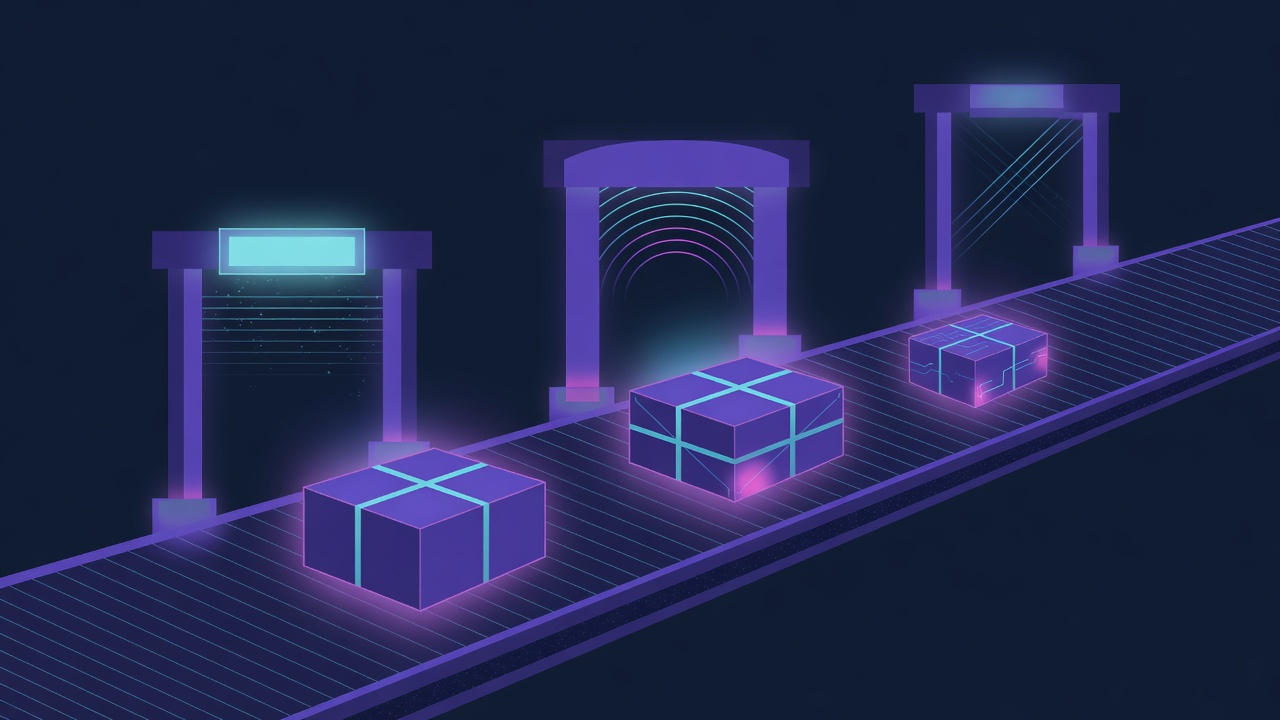
Cost Is the Floor, Control Is the Multiplier
You are two products in, three repositories deep, and the agent count keeps climbing. There is a PRD queue on one machine, an explorer swarm on another, and a migration branch nobody remembers authorizing. The hard question is no longer whether the agents can write the code. It is whether you can answer, on demand and with proof: what was done, by which worker, under whose authority, and why it was allowed. Managing multiple products, repositories, agents, and PRDs has become operationally overwhelming — and that overwhelm is not a personal discipline failure. It is what throughput without governance feels like from the inside.
This post expands section 8 of the Koinessa brain white paper, Business value III — better and faster, which states the argument's thesis in one line: cost is the floor; control is the multiplier.
Cost is the floor, control is the multiplier
The cost case for local-first agentic delivery is real — cache-read-heavy token telemetry, customer-controlled compute, no per-seat SaaS tollbooth on your inference — and a sibling post, the local-first cost advantage, walks through those numbers. But cheaper tokens are table stakes. A 30% cheaper operation that you cannot account for is still an operation you cannot account for. What multiplies the value of agentic speed is control: the ability to raise how much work agents do autonomously without losing the answer to "what happened, and who allowed it." Section 8 of the white paper breaks that control into concrete, individually verifiable properties. Here is what each one actually is.
Provenance: a chain from intent to deployment
The first property is live today: every consequential action in the system carries a provenance chain from intent to outcome — requirement, work item, principal, agent session, model, files, commit, pipeline, evidence, policy decision, approval, deployment, operational result. A temporal ledger makes "what did we believe when this was authorized" answerable as a query, not an archaeology project.
This matters because the overwhelm in the opening paragraph is mostly a missing-record problem. When a client, investor, or security reviewer asks why a change shipped, the honest answer in most agentic setups is "someone would have to reconstruct that from chat transcripts." The white paper's position is that governance is not a slide deck; it is a table you can audit. Provenance is what turns "trust me, the agents are careful" into signed evidence with a queryable history — which is also the foundation the risk-tiered autonomy model builds on: you cannot safely raise an autonomy tier if you cannot first prove what the lower tier did.
Identity, separated the way IAM separates it
The second property, also live, is identity. Koinessa separates identity the way mature IAM systems do — principal identity (who is operating), tenant/project identity (whose resources are in scope), agent/session identity (which worker is acting), work authority (which bounded task it owns), capability authority (which action classes it may perform), provider identity, and evidence identity. Permissions are evaluated against versioned policy with persisted decisions, not against prompt text; quotas and write scopes attach per principal and per table; and the audit and event ledgers stamp the acting principal on every entry.
Two external anchors explain why this design looks the way it does. The policy model follows Open Policy Agent, the CNCF-graduated general-purpose policy engine whose core idea is decoupling the policy decision from the software that enforces it, so that policy is versioned, reviewable code rather than behavior scattered through handlers. The trust model follows NIST SP 800-207, Zero Trust Architecture (Rose, Borchert, Mitchell, Connelly, August 2020), which defines zero trust as granting no implicit trust to assets or accounts based on network location or ownership — authentication and authorization are discrete functions performed before any session is established. Koinessa applies that doctrine internally, to its own LAN: a network connection grants no implicit trust, reads themselves are bearer-identified on any non-loopback bind, and a worker may be able to reach a resource while lacking the policy authority to use it. Both facts are checked, separately.
For a founder, the practical translation is that "the agent did it" stops being a valid explanation for anything. Every actor — human, agent session, provider — is a distinct principal with distinct authority, and every grant is a persisted decision you can review after the fact.
Three tenancy properties, three evidence boundaries
"Multi-tenant" is usually marketed as one promise. Section 8.3 of the white paper splits it into three properties with different evidence boundaries, and keeps their capability labels honest:
-
Data tenancy — in flight. Of 346 base tables, 333 carry
project_idand 13 shared or infrastructure tables do not. Every external write crosses a single-writer gateway where identity and scope are enforced. But the paper explicitly does not infer universal tenant isolation from a partial schema property: the tenant-hardening work items TEN-001 and MTC-001 sit at 78% (in flight) and 81% (in review) respectively, and external-principal hardening remains incomplete. That qualifier is the point — the claim is exactly as strong as the evidence. -
Concurrent operator tenancy — live. Two people routinely work at the same time on the same repository from two different PCs on the same local network, each directing their own agent swarms. The main PC serves the Brain gateway and the local Ollama daemon; the second workstation is a first-class LAN client of that host, not a copy of the database. File claims, work-item leases, and fencing tokens are what make it safe — the coordination plane does not care which human, which vendor, or which physical box a worker sits on. If you are the overloaded founder in the opening paragraph, this is the property a larger team is buying when they buy the control plane: not a promise that two chat windows can be open, but a demonstrated fact that two humans plus many vendor swarms can share one mainline without colliding.
-
Inference-plane portability — live where receipted, broader neutrality planned. The same board, the same leases, and the same evidence gates accept interactive workers from Kimi, Claude, Grok, Codex, custom local Ollama models, and Ollama Cloud — Ollama's documented model for offloading execution to its cloud service while callers keep using the Ollama interfaces, with local-only mode available. A seventh vendor, Devin, is registered as a descriptor and disabled. Current runtime receipts come from those interactive lanes; the managed transport layer that would make a provider swap configuration-only is built-but-gated with no descriptor enabled. A provider swap is an internal design goal, not externally proven neutrality.
The buyer-facing consequence: tenant isolation, concurrent-operator safety, and model neutrality are verified the same way code is — as evidence under a six-state result model — not asserted as a contractual promise.
The 2026-08-12 receipt: one day on a 266-card board
Control claims need receipts. The white paper's clearest one is a single repository receipt from 2026-08-12: one orchestrating session scanned the then-266-card work board, ran two explorer agents in parallel to map two code seams, had a local 27B model draft the requirements document from their reports, ran two coder agents in parallel on disjoint workstreams implementing four stories, and then independently re-ran the full verification suite — 11,271 tests green — before the work was accepted. No session's context held the project; the Brain did. That is persistent shared memory doing the coordination job, and it is a receipt, not a benchmark: one recorded day of one operation, presented as existence proof rather than a productivity multiplier.
External measurement gives this a bounded comparison. A 2026 study of agent-authored pull requests (arXiv:2607.04697, using the AIDev-pop dataset of 33,596 PRs across 2,807 repositories) found that only 0.5% of co-active pairs — pairs of agent PRs open at the same time, not 0.5% of all pull requests — involved two different agents, and in a replay sample of 747 pairs, textual Git conflicts hit 41.7% for cross-agent pairs versus 19.8% for same-agent pairs. Those are textual conflicts, not semantic ones, and the sample is one pair per repository — but the direction is unambiguous: the moment more than one agent vendor works the same repo, collision risk roughly doubles. Cross-agent concurrency is exactly the scenario Koinessa's claims, leases, and fencing tokens exist to govern.
Why the market is asking for this now
Two more external sources frame the demand side. DORA's research program — the 2025 State of AI-assisted Software Development report and its 2026 ROI follow-up — frames AI as an amplifier of the organization around it and names the cost of weak amplification the "verification tax": output arrives faster than the organization can confirm it. And Duma et al., in "These Aren't the Reviews You're Looking For" (EASE 2026), found that agentic pull requests tend to substitute human review rather than scale it — reviewers change what they do when the author is an agent, in ways that do not add scrutiny proportionally. Put together: generation speed is not the bottleneck, review capacity does not stretch to meet it, and the gap lands on whoever owns the release. That person is you.
Who this is built for
Section 8.8 is blunt about the intended customer: the platform, developer-experience, and security teams that own agentic delivery at organizations already running several AI coding agents against mature CI/CD — the teams asked, after the fact, what was done, by which worker, under whose authority, and with what proof. The controls exist so such a team can raise autonomy tiers across many developers without losing that answer, and so the evidence bundles map onto established assurance expectations: the NIST AI Risk Management Framework and its Generative AI Profile (AI RMF 1.0 and AI 600-1), and the Secure Software Development Framework (SP 800-218 v1.1 plus SP 800-218A, the generative-AI community profile, final 2024). These are voluntary frameworks, not certifications — the claim is that provenance, policy-as-code, and per-principal audit produce the kind of artifacts those frameworks ask for, not that any badge has been earned.
The founders' own operation — three small businesses run on one agent setup — is the origin of the design and its daily proving ground, not its intended scale. And the paper holds itself to its own standard: a deliberately skeptical external assessment on 2026-08-13 fact-checked the citations, labeled planning assumptions as assumptions, refused any whole-task productivity multiplier, and found the underlying problem real — while leaving one condition unmet: finish the trust substrate before asking trust-sensitive organizations to rely on it. That substrate has since closed, and its successors are held to the same standard.
The takeaway
The overwhelm of managing many products, repositories, agents, and PRDs is not solved by faster agents or cheaper tokens — it is solved by making every action attributable, every authority explicit, every tenancy claim evidenced, and every acceptance gate fail-closed. Cost is the floor; control is the multiplier, and control is only real when it is queryable. Koinessa's position is that you should never have to take any of that on faith: the provenance chain, the identity model, and the swarm receipts are operating facts with snapshot dates and qualifiers attached. The full argument, with every number, qualifier, and citation in context, is in the Koinessa brain white paper — section 8 is where the business case for control lives.